
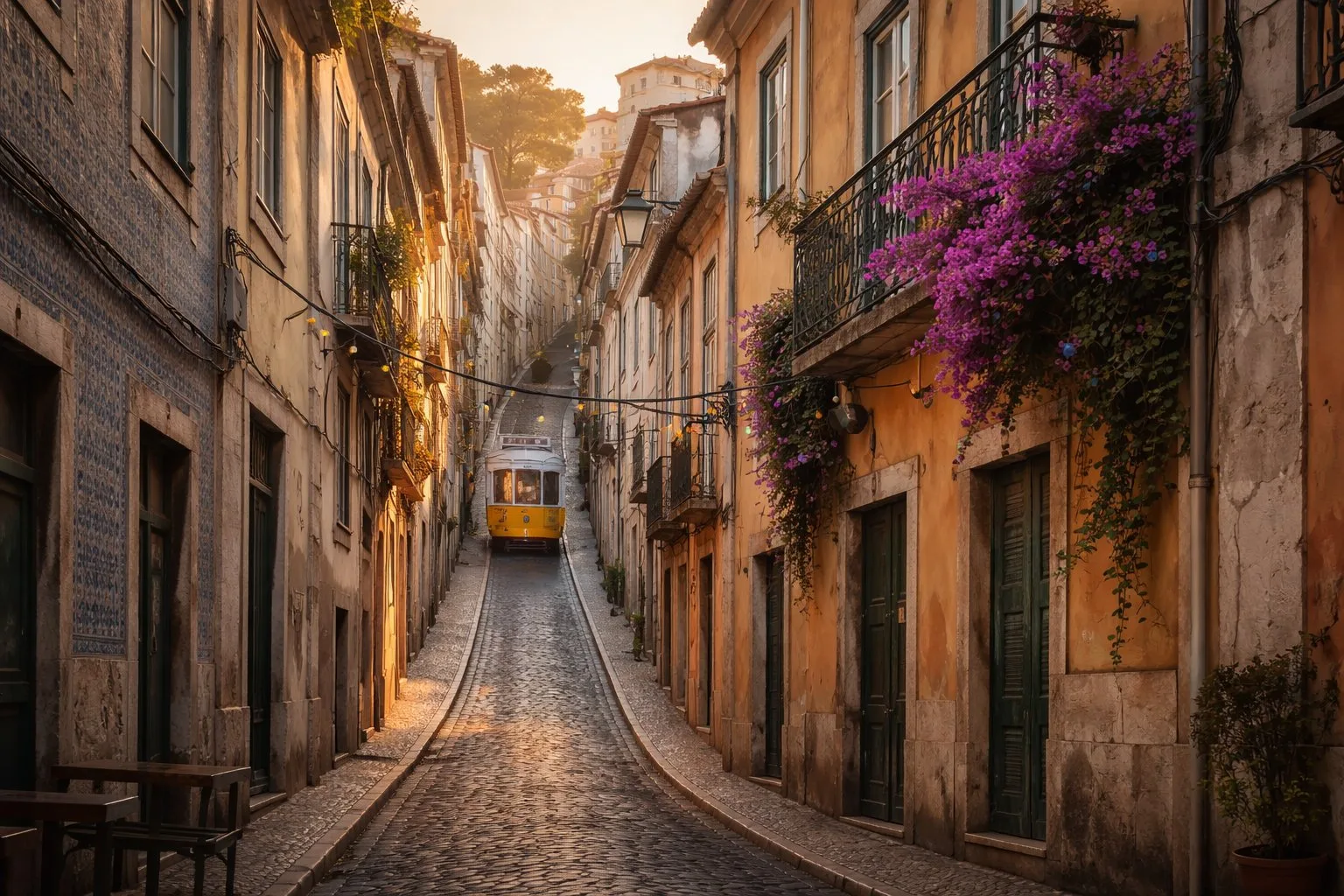
There’s a quality to the light in Lisbon that people try to describe and never quite manage. It’s not just bright — it’s warm, low, golden, the kind of light that makes every crumbling façade look like it was arranged for a painting. In spring, this light arrives early and stays late, filling the narrow streets of Alfama, bouncing off azulejo tiles in blues and whites, turning the Tagus estuary into a sheet of hammered copper by late afternoon.
Portugal in spring is a country at its most honest. The summer crowds haven’t arrived. The prices haven’t climbed. The restaurants are full of locals, not tour groups. And the weather — 18 to 24 degrees, sunshine most days, the occasional soft rain that passes quickly — is as close to perfect as European travel gets.
This is shoulder season, and it might be the best-kept secret in European travel. Except it’s not really a secret anymore. People are starting to figure it out. So here’s everything you need to know before they all do.
Why spring changes everything
Summer in Portugal is hot. Genuinely, unrelentingly hot — 35 degrees in Lisbon, 40 in the Alentejo, the kind of heat that empties the streets between noon and four. The Algarve beaches are packed shoulder to shoulder. Sintra’s palaces have two-hour queues. Porto’s riverfront becomes a slow-moving wall of selfie sticks.
Spring is none of that. The air is warm but not heavy. You can walk for hours without wilting. The beaches exist in that magical state where the sand is clean, the water is cold but bearable, and you can find a stretch of coastline entirely to yourself. Restaurant terraces that will have hour-long waits in July? You walk straight in, sit down, and someone brings you wine.
And then there’s the landscape. March and April turn the countryside green in a way that visitors who only know summer Portugal wouldn’t recognise. Wildflowers blanket the Alentejo plains. The Douro Valley’s terraced vineyards are vivid and lush. Even the Algarve cliffs, usually baked to a sandy beige, are edged with yellow gorse and sea lavender.
The light is different too. Lower sun, longer shadows, the kind of soft warmth that photographers call “golden hour” — except in Portugal it lasts most of the day.
Lisbon — the city that asks you to get lost
Lisbon isn’t a city you navigate. It’s a city you wander. The streets were laid out centuries before anyone thought about grid plans, and they climb, twist, dead-end, and suddenly open onto a viewpoint — a miradouro — where the whole city spreads below you, terracotta rooftops running down to the river.
Start in Alfama, the oldest neighbourhood. Narrow alleys barely wide enough for two people, laundry hanging between buildings, the sound of fado drifting from somewhere you can’t quite locate. In spring, the doors are open, the bougainvillea is blooming over the walls, and the whole quarter feels like it’s exhaling after winter.
Walk up to Miradouro da Graça or Miradouro da Senhora do Monte for the panoramic views. Take Tram 28 if you can board it — the vintage yellow carriages grind up Lisbon’s steepest hills, and in spring the queues are short enough to actually enjoy the ride instead of treating it as an endurance test.
Cross to Belém for the Jerónimos Monastery and a pastel de nata from Pastéis de Belém — the original, the one that’s been making custard tarts since 1837. Eat it warm, standing outside, dusted with cinnamon. Some things don’t need improving.
The LX Factory, a converted industrial complex in Alcântara, is where Lisbon’s creative side lives — bookshops, studios, weekend markets, and restaurants built into old printing presses. Time Out Market, in the Cais do Sodré neighbourhood, gathers Lisbon’s best food stalls under one roof. Both are walkable, both are better in spring when you’re not competing with cruise-ship crowds.
Having data on your phone makes Lisbon significantly easier. The hills are deceptive — what looks like a short walk on the map can involve a 200-step staircase. Google Maps with live transit shows you when the next tram or elevator is coming. And finding those hidden miradouros — the ones without “miradouro” signs, just a break in the buildings and a bench facing the river — is exactly the kind of discovery that a phone with data makes possible.
Porto — the quiet masterpiece
If Lisbon is the extrovert, Porto is the one standing in the corner with better taste. It’s smaller, grittier, more concentrated. The Ribeira district tumbles down to the Douro River in a cascade of narrow houses painted in ochre, terracotta, and faded blue. Across the water, the port wine lodges of Vila Nova de Gaia line up along the opposite bank, their names — Sandeman, Taylor’s, Graham’s — painted on the rooftops in letters big enough to read from the bridge above.
That bridge is the Dom Luís I, a double-decker iron structure that’s become Porto’s defining image. Walk the upper deck for the views. Then cross back on the lower deck, at river level, where the tourist boats depart for Douro Valley cruises.
Porto’s food scene is extraordinary and unpretentious. A francesinha — the city’s signature sandwich, a tower of bread, ham, sausage, and steak drowned in melted cheese and a spiced tomato-beer sauce — costs about eight euros and will keep you full for the rest of the day. Pair it with a Super Bock in a tiled tasca where nobody speaks English and the menu is handwritten on the wall. That’s Porto at its best.
For port wine, skip the big-name lodges and book a tasting at a smaller house. You’ll learn more, taste better vintages, and spend less. The ten-year and twenty-year tawnies are revelations — nothing like the cheap ruby port most people have tried elsewhere.
São Bento station is worth visiting even if you’re not catching a train. The entrance hall is covered in over 20,000 blue-and-white azulejo tiles depicting scenes from Portuguese history. In spring light, with the morning sun coming through the windows, it’s genuinely breathtaking. Livraria Lello, nearby, is often called one of the most beautiful bookshops in the world — and for once, the claim is fair.
Day trips — Sintra, Cascais, and the coast
Sintra is a 40-minute train ride from Lisbon and feels like stepping into a fairy tale that someone forgot to finish. The Pena Palace sits on top of a forested hill, painted in reds and yellows that shouldn’t work but absolutely do, surrounded by gardens where peacocks wander between exotic trees. The Quinta da Regaleira, below, is a Gothic revival estate with underground tunnels, initiatic wells, and hidden grottoes. It’s strange and wonderful.
In summer, Sintra is overrun. Two-hour queues for the palace, packed shuttle buses, car parks full by 10 a.m. In spring, you arrive at opening time, walk straight in, and have rooms mostly to yourself. This alone is reason enough to visit Portugal before June.
Cascais is the opposite experience — a relaxed coastal town 30 minutes west of Lisbon by train. Pastel-coloured houses, a small beach, excellent seafood restaurants along the waterfront. Walk or cycle the coastal path to Guincho Beach, where surfers ride Atlantic swells against a backdrop of the Sintra mountains. In spring, the wind is fresh, the light is crystalline, and the whole stretch feels wild and alive.
Further north from Porto, the Minho region borders Spain and feels like a different country entirely — stone villages, vineyard-covered hillsides, the Peneda-Gerês National Park with its granite peaks and glacial lakes. Almost no international tourists, even in summer. In spring, it’s yours.
The Douro Valley — slow and golden
The Douro Valley is Portugal’s wine country, and in spring it’s at its most vivid. Terraced vineyards rise from the river in geometric patterns that haven’t changed in centuries. The vines are bright green with new growth. Almond trees blossom white and pink along the slopes. The river, dark and still, reflects the hillsides like a mirror.
You can reach the valley by car from Porto in about two hours, following the river east along the N222 — frequently named one of the most beautiful drives in the world. You can also take the train from São Bento to Pinhão, a three-hour journey through tunnels and along cliff edges with views that make passengers audibly gasp.
Pinhão is the heart of the valley. A tiny town with a train station decorated in azulejo tiles depicting the wine harvest, a handful of quintas offering tastings and tours, and restaurants where the menu is whatever was caught or picked that morning. Book a night at a vineyard estate — you’ll eat dinner overlooking the terraces, drink wine made from grapes grown on the slope in front of you, and fall asleep to silence.
River cruises run from Porto through the valley, passing through locks and under bridges, with wine tastings at estates along the way. A full-day cruise is a beautiful way to see the landscape without driving. Just bring sunscreen — the valley is sheltered from Atlantic weather, and even in April the sun reflects off the water with real intensity.
The Algarve — before the crowds claim it
The Algarve in summer is package holidays and beach resorts. The Algarve in spring is something else entirely — a coastline of sandstone cliffs, hidden coves, and sea caves that feels almost untouched.
The Seven Hanging Valleys Trail runs along the clifftops between Praia da Marinha and Vale Centeanes — about six kilometres of the most dramatic coastal scenery in Europe. The path winds past blowholes, rock arches, and beaches only accessible by steep wooden staircases. In spring, the clifftop scrub is covered in wildflowers and the only sound is the Atlantic crashing below.
Benagil Cave — the famous sea cave with a skylight open to the sky — is best visited by kayak from the beach. In spring, tours are easy to book same-day and the cave itself isn’t crowded with boats. The light comes through the opening in the roof and hits the sand in a circle that shifts with the sun.
Lagos, on the western edge of the Algarve, has the best mix of town and coast. A pretty old centre with low-key bars and good seafood, and within walking distance, Ponta da Piedade — a formation of golden sea stacks and grottoes that looks like it belongs in a different geological era. Take a boat from the marina for the close-up view.
The water temperature in spring is around 16 to 18 degrees — cold enough to take your breath away, warm enough to swim if you commit. The air is 20 to 24 degrees most days. Evenings are cool enough for a light jacket and a glass of vinho verde on a terrace watching the sun go down.
What to eat, what to drink
Portuguese food is honest. Nothing is over-garnished, over-complicated, or arranged on the plate for a photograph. It’s grilled fish, it’s stews, it’s bread and olive oil and a bottle of wine for five euros. And it’s extraordinary.
In Lisbon, eat bacalhau — salt cod, prepared in what the Portuguese claim are 365 different ways. Bacalhau à Brás, shredded with eggs and crispy potatoes, is the entry point. In Porto, it’s the francesinha. Along the coast, it’s whatever fish came off the boat that morning, grilled whole with a squeeze of lemon. In the Alentejo, pork and clams cooked together in a cataplana — a copper clamshell pot — is the dish you didn’t know you’d been waiting for.
Pastéis de nata are everywhere and almost always good. The custard tart is to Portugal what the croissant is to France — ubiquitous, simple, and almost impossible to make badly. Eat them warm. Eat them often.
Vinho verde — young, slightly fizzy, low-alcohol white wine — is the spring drink. It’s crisp, refreshing, and costs almost nothing. For something more serious, the Douro reds are world-class and still absurdly underpriced compared to French or Italian equivalents. And port wine, tasted properly in the Douro Valley or a Gaia lodge, will recalibrate everything you thought you knew about it.
Coffee culture is strong and specific. An espresso is a bica in Lisbon, a cimbalino in Porto. It arrives in a tiny cup, it costs 70 cents to a euro, and it’s better than most of what you’ll find in countries that charge four times as much. Stand at the bar like the locals do.
Practical tips for spring in Portugal
Fly into Lisbon or Porto — both airports are well-connected to the city centre. Lisbon’s airport is remarkably close to downtown; a taxi to Baixa takes about 15 minutes. Porto’s airport connects to the city by metro in under 30 minutes.
Accommodation in spring is 30 to 50 percent cheaper than summer. Book a few weeks ahead for Lisbon and Porto; the Algarve and Sintra are even more flexible. Apartments in the old quarters offer better value and more character than hotels.
Portugal’s trains are clean, affordable, and scenic. The Lisbon-to-Porto route takes about three hours. Regional trains to Sintra, Cascais, and the Algarve are frequent and cheap. Within cities, Bolt is cheaper than Uber and available everywhere.
Learn four words of Portuguese: obrigado (thank you), bica (espresso), conta (the bill), saúde (cheers). The Portuguese appreciate the effort disproportionately. Most people under 40 speak good English, but the attempt matters.
And sort your connectivity before you leave. Portugal has excellent 4G coverage, but EU roaming charges apply for non-EU visitors, and local SIM cards mean finding a carrier store and waiting. An IbiPoint eSIM for Portugal activates before you even land — maps, transit, translation, and restaurant lookups all live from touchdown. In a country where the best experiences are found by wandering off the obvious path, having a phone that works is the difference between finding that hidden miradouro and walking past it.
The golden hour country
There’s a moment in the early evening, around six or seven, when Lisbon does something that no other city in Europe quite manages. The sun drops low over the Tagus and the entire city turns gold. Not metaphorically. Literally gold — the tiles, the stone, the river, the light itself. People stop on the miradouros and just look. Nobody says much. The trams rattle past below. Somewhere in Alfama, someone starts singing fado, and the voice drifts up through the streets, thin and clear.
Portugal doesn’t try to impress you. It doesn’t need to. The beauty is structural — it’s in the light, in the tiles, in the way a plate of grilled sardines arrives on a table overlooking the Atlantic. It’s in the way the Douro bends between the vineyards, and the way the surf hits the Algarve cliffs, and the way an 80-year-old woman leans out of her window in Porto to hang laundry with the same view behind her that tourists cross oceans to see.
In spring, before the heat and the crowds and the inflated prices, all of this is simply there. Unhurried. Unguarded. Waiting for anyone who knows enough to come early.
The sun is already warm. The tables are still empty. Go now.
Planning a Portugal trip? Talk to IbiPoint Support — we’ll help you pick the right plan so you can focus on the pastéis de nata.