
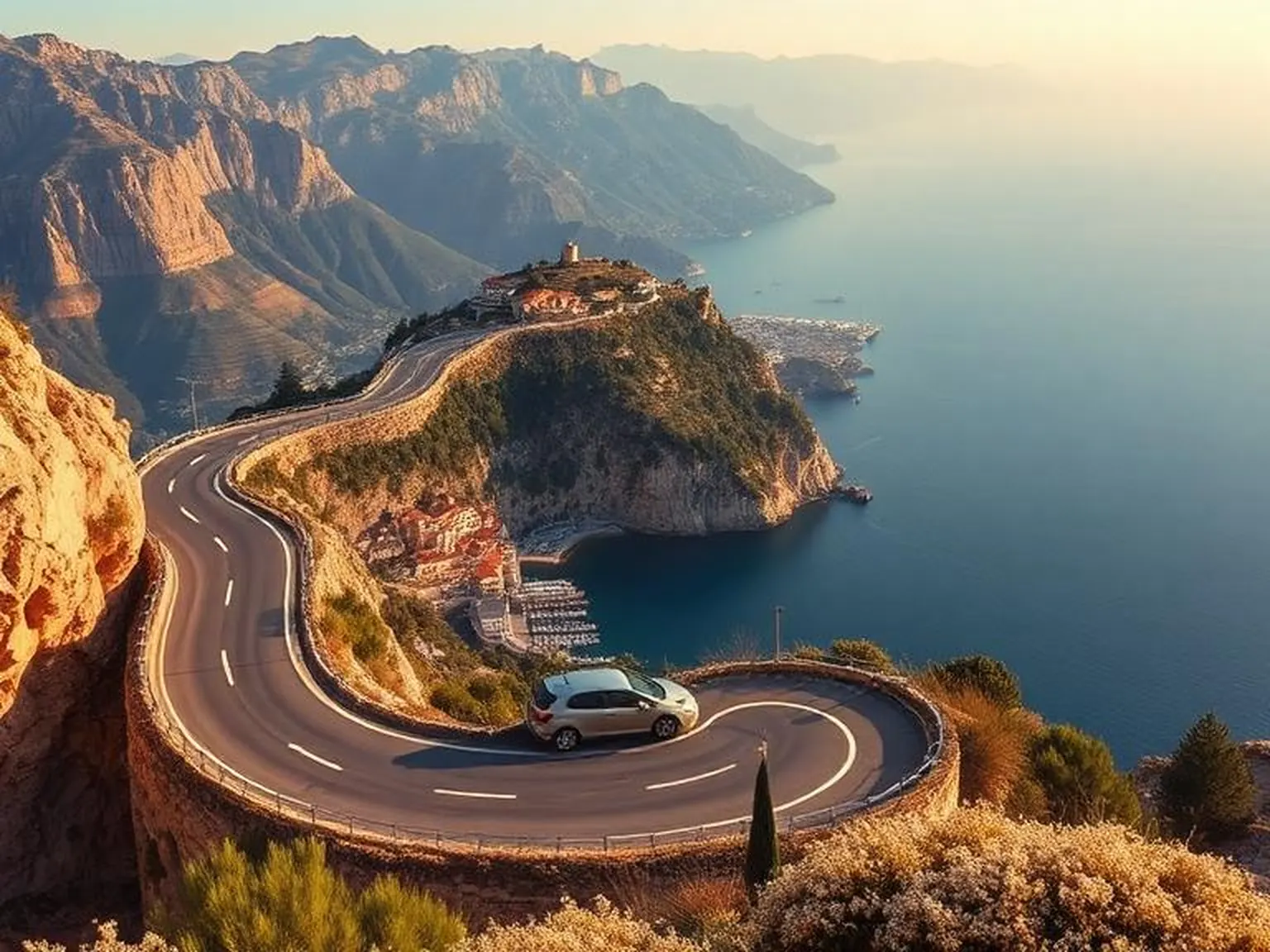
Most great European road trips have a problem. The roads are too crowded, the prices are too high, or the route is too well-trodden to feel like a discovery anymore. The Amalfi Coast is a car park. The French Riviera is a queue. Even the Scottish Highlands have a North Coast 500 traffic jam in July. The continent’s most photographed coastlines have, for the most part, run out of road for anyone looking for the version of European travel that still feels open.
There is one exception. A two-week drive that begins on a medieval city wall above the Adriatic, crosses five borders, passes through six countries, climbs mountain passes that have only been paved in the last decade, and ends at the gateway to Mount Athos. Coastal cliffs. Ottoman bazaars. Lakes the colour of mineral water. Stone bridges over emerald rivers. Prices that make the rest of Mediterranean Europe look like a tax. And almost nobody driving it.
This is the Balkan road trip. The continent’s last great undiscovered route.
The route, in one sentence
Dubrovnik to Thessaloniki via Mostar, Kotor, Tirana, Berat, and Ohrid. Six countries — Croatia, Bosnia and Herzegovina, Montenegro, Albania, North Macedonia, and Greece — in fourteen days. Roughly 1,400 kilometres of driving, half of it along coastline, half through mountains. The route works in either direction, and any segment of it stands alone as a shorter trip if two weeks is too much. We will describe it southbound, because southbound is how the light works and how the borders flow easiest.
You can do shorter versions. A four-country loop — Croatia, Bosnia, Montenegro, back to Croatia — runs comfortably in a week. A Greece-end-only version, starting in Tirana and finishing in Athens, works in ten days. But the full Dubrovnik-to-Thessaloniki arc is the one that gets under your skin. It is six distinct cultures stitched together by a single coast and a single mountain range, all within a single car’s odometer.
Why now, why this trip
Three things have happened in the last decade that make this drive better than it has ever been. The roads have been rebuilt — Albania’s coastal SH8 in particular is a different road from what it was even five years ago. The Montenegrin border points have streamlined to the point where most crossings take under ten minutes. And the guesthouse scene across Bosnia, Albania, and North Macedonia has matured into a network of family-run places with a kind of hospitality that the chain-hotel coastlines of the western Mediterranean stopped offering a generation ago.
The crowds haven’t caught up yet. Dubrovnik and Kotor are busy, certainly. But step inland for two hours and you are alone. Mostar has a few tour buses at lunchtime and silence by 7 p.m. Berat — a UNESCO World Heritage city of Ottoman stone houses stacked up a hillside — sees a fraction of the tourists of Hvar or Santorini, and costs a third as much. Ohrid, the lake town that gave its name to one of Europe’s oldest alphabets, is what a Greek island would look like if the Greeks had never invented the package holiday.
The window matters. In ten years, this will be a different drive. The Albanian Riviera will be priced like Croatia. Bosnia will have its first overcrowded summer. North Macedonia will discover what its lakeshore is worth. None of these are bad outcomes for the countries themselves — but for travellers, the smart move is to go before the pricing converges with the rest of Europe. That window is open right now.
Day 1–3 — Dubrovnik and the Croatian coast
Pick up the car in Dubrovnik. The walled city is the obvious starting point, and worth two nights even though the day-trip crush from cruise ships makes the middle of the day unpleasant. Walk the walls at 7 a.m. before the gates open to the tour groups, find dinner in the back streets of the old town after 8 p.m. when the day-trippers have left, and use the middle of the day for the beaches outside the walls — Banje, Sveti Jakov, the rocky coves of Lokrum island a short ferry away.
The drive south out of Dubrovnik is one of the great underrated stretches of European coastline. The D8 highway runs above the sea on a series of cliffs, with the Pelješac peninsula visible across the water and the green Konavle valley folded into the hillsides. There is no toll, no traffic, and one of the best lunch stops on the route — the village of Cavtat, half an hour from the airport, where the seaside restaurants serve the previous night’s catch at prices Dubrovnik forgot a decade ago.
Croatia’s last detour before the Bosnian border is the Pelješac peninsula itself. The new bridge across the Mali Ston bay, opened in 2022, lets you cut into the peninsula without going through Bosnian territory — a small marvel of engineering and an even better excuse to spend a morning at the Ston salt pans, the oldest in Europe, where the local oysters are graded by hand and served raw at the harbour. From Ston, head back to the main road and aim east.
Day 4–5 — Bosnia, the mountain heart
The Croatia–Bosnia border at Neum or Klobuk takes about ten minutes if your paperwork is in order. You ask for your insurance green card, the officer scans your passport, and you are in a different country with a different alphabet, a different currency (the convertible mark, pegged to the euro), and a different mood. Bosnia is quieter than Croatia. The roads have less traffic, the prices fall by a third, and the scenery shifts from coastal to mountainous within the first thirty minutes of driving.
The road climbs through the Neretva valley toward Mostar, following one of the most photogenic river canyons in Europe. Emerald water, white limestone cliffs, occasional ruins of mosques and orthodox churches sitting opposite each other across the valley. The drive itself is the attraction. Stop at the old railway viaducts near Počitelj, an Ottoman village clinging to the cliff above the road, and walk up through its stone alleys to the fortress at the top. Almost nobody else will be there.
Mostar is two nights minimum. The famous arched bridge — Stari Most, rebuilt after the wars of the 1990s — is the photograph everyone takes. But the bridge is not the point of the town. The point is the bazaar that wraps around it, the small workshops where coppersmiths still hammer trays by hand, the riverside restaurants serving grilled trout and ćevapi to a soundtrack of Bosnian coffee being poured from copper pots. Stay in a guesthouse in the old quarter — most cost €40 a night for two — and walk everywhere.
An hour west of Mostar, the Kravice waterfalls drop in a wide curtain into a swimmable pool. Get there before 11 a.m. or after 5 p.m. and it is yours. The local restaurant beside the falls grills lamb on a spit and asks €12 a person for a meal that would cost three times that in Italy.
Day 6–7 — Montenegro, the cinematic coast
The drive from Mostar to Kotor crosses two borders if you stick to the coast — back into Croatia briefly, then into Montenegro at the southern tip. The alternative is the inland route through Trebinje, a beautiful Bosnian wine town that almost no tourists visit, then south into Montenegro through a single border post at Kostanjica. Either way, you will be on the Bay of Kotor by mid-afternoon.
The Bay of Kotor is, by some distance, the most cinematic stretch of the entire route. A fjord-like bay carved into the limestone, with the mountains rising 1,700 metres almost vertically from the water, dotted with stone villages that have been there since the Venetian period. Kotor itself — the walled old town at the head of the bay — is a smaller, denser, more atmospheric Dubrovnik with half the tourists and a third the prices. Climb the fortress walls above the town at sunset. It is one of the great views in the Mediterranean and almost nobody is on it after 6 p.m.
If you have one extra day, the drive over the Lovćen mountain — the road of twenty-five hairpins, climbing from sea level to 1,200 metres in fifteen kilometres — is the most spectacular short drive in the Balkans. At the top, the mausoleum of Petar II Petrović-Njegoš sits on a peak with views that on a clear day stretch to Albania, Croatia, and Italy. The road is narrow and slow but entirely paved and entirely empty.
Budva, an hour south of Kotor, is the resort half of Montenegro and worth skipping unless you specifically want a beach day. The real next stop is further south — Sveti Stefan, the fortified island village turned luxury hotel, viewed from the public beach to the north. You cannot enter the island unless you are a guest, but the photograph is free, and there is a small fishing village called Petrovac twenty minutes further down the coast that has the best seafood in southern Montenegro at half the Budva price.
Day 8–10 — Albania, the surprise of the trip
The Montenegro–Albania border at Sukobin or Hani i Hotit is the first border on this route where you will notice a meaningful change. Albania is poorer than its neighbours, and it shows in the first kilometre — the roads are slightly rougher, the villages slightly more haphazard, the petrol stations more numerous and more competitive. But within an hour the impression flips. Albania, almost more than any country in Europe right now, is on its way up. New highways. New hotels. New restaurants. And a coastline — the Albanian Riviera — that the Croatian and Greek coasts looked like fifty years ago.
The drive south from the border takes you past Shkodër, the cultural capital of northern Albania, with a fortress on a hill and a lake the size of Lake Geneva straddling the border with Montenegro. Stop for lunch at one of the lakeside restaurants in Shiroka. Grilled carp, fresh bread, a salad of tomato and white cheese, a half-litre of local wine — under €15 a person, with one of the great lake views of Europe.
Tirana, the capital, is two hours further south. It is unlike any other capital on this route. Brightly painted communist-era buildings, a pyramid-shaped former museum being turned into an art space, a network of pedestrian streets full of cafés and bars, and a mountain — Mount Dajti — accessible by cable car from the eastern suburbs. One night in Tirana is enough; two if you want a slower city day.
Then comes the part of the trip that quietly steals the whole show. Berat, two hours south of Tirana, is a UNESCO city of white Ottoman houses stacked vertically on both sides of a river. The locals call it “the city of a thousand windows” — every house has the same shuttered design, and from across the river it looks like one enormous building covered in eyes. Two nights here. Walk up to the castle quarter — actually lived in, with a working population inside the ancient walls — and have dinner at one of the houses-turned-restaurants where a four-course meal with wine costs €18. Berat is the kind of place travel writers used to find before mass tourism made every old town predictable.
Before turning east toward North Macedonia, take a day on the Albanian Riviera. The drive from Vlorë to Sarandë along the SH8 coastal road climbs over the Llogara Pass — 1,000 metres above the sea — and drops down into a stretch of beaches that look like Greek islands without the prices. Himarë, Dhërmi, Jale, Ksamil. Crystal water. White pebbles. Beach restaurants serving grilled octopus for €10. In ten years, this coast will be Croatia. Right now, it is still Albania.
Day 11–12 — North Macedonia and the lake
The Albania–North Macedonia border at Qafë Thanë crosses through one of the great lake landscapes of the continent. Lake Ohrid, three million years old, one of the deepest lakes in Europe, sits in a basin shared between the two countries with the border running directly down the middle. The North Macedonian side has Ohrid town itself, which is one of the great underrated stops on the entire route.
Ohrid is described in older guidebooks as “the Jerusalem of the Balkans” because of the density of churches and monasteries along its lakeshore — 365 of them, supposedly, one for every day of the year. The historical centre is a stack of red-roofed stone houses dropping down to the lake, with a Byzantine fortress at the top and the cliff-edge church of Saint John of Kaneo as the postcard image. Two nights here, easily. The Saturday boat tours to the Sveti Naum monastery at the southern end of the lake are the best way to spend a half-day; the lakeside walks at dusk are the best way to spend an evening.
The food on the lake is its own discipline. Ohrid trout — endemic to the lake, protected, increasingly rare — appears on every menu, usually grilled with garlic and olive oil. Tavče gravče, the bean stew that is North Macedonia’s national dish, comes in a clay pot from a wood-fired oven. Ajvar, the red-pepper relish, accompanies almost everything. And the wines — Macedonian reds from the Vardar valley — are one of the best-value finds of the entire trip. A bottle of Tikveš Vranec in a good restaurant costs €8.
If time permits, spend an afternoon in Bitola, two hours east, which feels like a Habsburg city dropped into the Balkans. Long pedestrian boulevards, neoclassical facades, French and Greek consulates that have been there since the nineteenth century. It is one of the loveliest small cities on the entire route, and almost no foreign traveller stops there.
Day 13–14 — Greece, the long exhale
The final border, North Macedonia to Greece at Bogorodica/Evzoni, drops you back into the European Union and onto the long fertile plain of central Macedonia. The driving gets easier — motorway most of the way, signs in two scripts. The pace of the trip slows.
Thessaloniki is the natural ending point. Greece’s second city, a port that has been continuously inhabited since 315 BC, with a waterfront that runs for five kilometres along the Thermaic Gulf and a food scene that quietly rivals Athens. The White Tower at the eastern end of the seafront, the Roman forum near the centre, the Ano Poli — the upper town — with its Ottoman houses and Byzantine churches, all walkable from a single hotel near Aristotelous Square.
Eat. Thessaloniki is where the trip pays off in food. The bougatsa pastries at Bantis, the mussels with feta at Mourga, the seafood mezedes at the rebetiko bars in the Ladadika district, the small grilled fish at the Modiano market. Combined with the wine you have been drinking for the previous twelve days — Croatian Pošip, Bosnian Žilavka, Montenegrin Vranac, Albanian Kallmet, Macedonian Tikveš, now Greek Assyrtiko — and the trip ends as it should: at a table, in front of the water, with no further driving to do.
For travellers with an extra two or three days, the Halkidiki peninsula east of Thessaloniki — three fingers reaching into the Aegean, including the monastic republic of Mount Athos on the third — is the best beach extension in the region. Otherwise, fly home from Thessaloniki airport, leave the car at one of the agencies that allows in-country one-way returns, and have your last meal at the airport with the taste of grilled octopus still in your mouth.
The connectivity problem — and the obvious fix
This is the one part of the Balkan road trip that historically defeated even seasoned travellers. Six countries, four of which sit outside the European Union, with no roaming agreements between most of them. The old solution was to buy a local SIM at each border — six cards, six top-ups, six different prepaid systems, six hours of your trip spent in carrier shops trying to understand pricing menus in Albanian or Macedonian. Or to pay roaming charges that, in Albania and Bosnia, used to run to €5 per megabyte. Either way, the connectivity question turned a beautiful road trip into a logistical headache.
A regional eSIM ends the question in a single purchase. An IbiPoint Europe plan covers Croatia, Bosnia, Montenegro, Albania, North Macedonia, and Greece on one activation, switching networks automatically every time you cross a border. No carrier shop. No swap. No top-up. The eSIM activates before you fly to Dubrovnik, and from the moment you land it is working — Google Maps for navigation, Waze for live traffic warnings, Booking.com for the next guesthouse, Google Translate for the wine list, Revolut or Wise for currency conversion at every border. The route crosses three scripts (Latin, Cyrillic, Greek) and at least four languages most travellers do not speak. A phone that just works, across all of it, is not a luxury. It is the thing that lets you actually drive the route instead of stopping every two hours to solve a problem.
Travellers planning the wider Balkans — including Serbia, Kosovo, or Bulgaria as an extension — should look at the Europe-wide regional plans, which cover all of these countries on a single SIM. IbiPoint plans run across 200+ countries, so even travellers continuing onward to Turkey, Egypt, or beyond stay on the same eSIM without a swap. The point is not the spec sheet. The point is that you stop thinking about it. The eSIM works. The trip works.
What to eat across the route
The Balkans have one of the most underrated food cultures in Europe. The Ottoman period left a layer of grilled meats, stuffed vegetables, and yoghurt-based sauces that runs through every country on the route. The Austro-Hungarian period in the north added cured meats and pastries. The Greek south brought olive oil, seafood, and the entire mezedes tradition. Across the entire drive, you eat well and you pay little.
In Croatia, the coastal specialities are black risotto from cuttlefish ink, peka (lamb or octopus slow-cooked under a bell of hot coals), and the salt-cured ham pršut from the karst hinterland. Wash it down with Pošip from Korčula or Plavac Mali from Pelješac. In Bosnia, it is all about ćevapi — small grilled sausages of minced beef and lamb served with onion and warm flatbread — and the Bosnian coffee ritual, which is closer to a half-hour conversation than a beverage. Add burek, the layered savoury pastry filled with meat, cheese, or spinach, which appears across every country on the route under different names.
In Montenegro, the lakeside restaurants of Skadar specialise in carp and eel; the coast adds buzara mussels and Adriatic oysters. Albanian food, the surprise of the trip for most travellers, runs from the byrek pastries of the north to the seafood of the Riviera; tavë kosi — lamb baked with yoghurt and rice — is the national comfort dish and worth seeking out in Berat or Gjirokastër. North Macedonia gives you tavče gravče, ajvar, lake trout, and the lyutenitsa pepper relish. Greece, by Thessaloniki, brings the full mezedes tradition — small plates ordered in volume, eaten over hours, served with ouzo or tsipouro and the sound of rebetiko music in the background.
Practical tips for the road
Rent the car in Croatia or Greece — not in any of the smaller countries in between. The international rental chains have full insurance options that cover the entire route, and one-way drop-offs work within Croatia (Dubrovnik to Split, for instance) but rarely across borders. The smartest itinerary is to start and end in the same country and accept a one-way internal return.
Ask the rental counter explicitly for cross-border permission for every country on your route. This is sometimes called a green card extension. Most agencies charge €30–60 for the document; some include it free. Drive without it and you can be turned back at the border. Get it in writing.
Carry physical cash for Bosnia, Albania, and rural North Macedonia. The cities take cards everywhere; the small towns and rural restaurants often still operate cash-only, particularly for the family-run places that are the entire point of the trip. ATMs are common but charge fees; pull larger sums less often. The euro is widely accepted in Montenegro (the official currency) and Kosovo, and tolerated in tourist areas of Bosnia and Albania, but you will need local cash for the smaller stops.
The border crossings vary in length. The EU borders — Croatia in and out, Greece in — can take an hour in peak summer because of paperwork checks; the non-EU borders are usually quicker. Try to cross any of them before 9 a.m. or after 6 p.m. when the bus and coach traffic thins. Have your passport, registration, green card insurance, and rental cross-border paperwork ready in a single folder on the passenger seat.
Drive defensively. Standards vary wildly across the route. Croatian and Greek roads are EU-standard. Montenegrin roads are excellent on the coast, narrow inland. Bosnian and Albanian roads have improved dramatically but still include patches of older asphalt, mountain hairpins with no guardrails, and the occasional surprise pothole. Avoid driving at night across borders or through the mountains; the scenery is worth seeing anyway, and the road conditions are dramatically easier in daylight.
And get connected before you leave home. The Balkans are the European route where a working data plan matters most. Six countries, three scripts, four to five languages most travellers do not read, and a road network where the latest improvements have not yet reached older GPS hardware. Your phone is your map, your translator, your booking platform, your currency converter, and your emergency contact. An IbiPoint eSIM activates before you fly and works the moment you land — one plan, six countries, every border crossed without a thought.
The Balkan road trip state of mind
The thing about this route — and the reason people who have driven it tend to repeat it — is that it gives you back something European travel had quietly stopped offering. The sense of arrival in a place that feels unprocessed. A guesthouse owner who has time to recommend a restaurant because you are the only foreign guest that week. A village square where the children are still playing football at 9 p.m. and the older men are still drinking coffee at the same table they have used for forty years. A road that climbs into the mountains and finds nothing at the top but a view and silence. A border crossing that takes ten minutes because the officer wants to talk about your trip.
None of this is hidden. The route is on every map. The towns are in every guidebook. What has not yet caught up is the volume of foreign cars driving it. For now, you are still part of a small wave. The Balkans are still the version of Europe that most of the continent has stopped being.
Two weeks. Six countries. One plan. A car you return at the end. And a stack of photographs, food memories, and unexpected hospitalities that will outlast almost every other holiday you take this year.
Go now — while the road is still open.
Croatia eSIM Bosnia eSIM Montenegro eSIM Albania eSIM North Macedonia eSIM Greece eSIM Europe regional eSIM
Planning a Balkan road trip? Talk to IbiPoint Support — we’ll help you pick the right plan so every border crossing just works.