
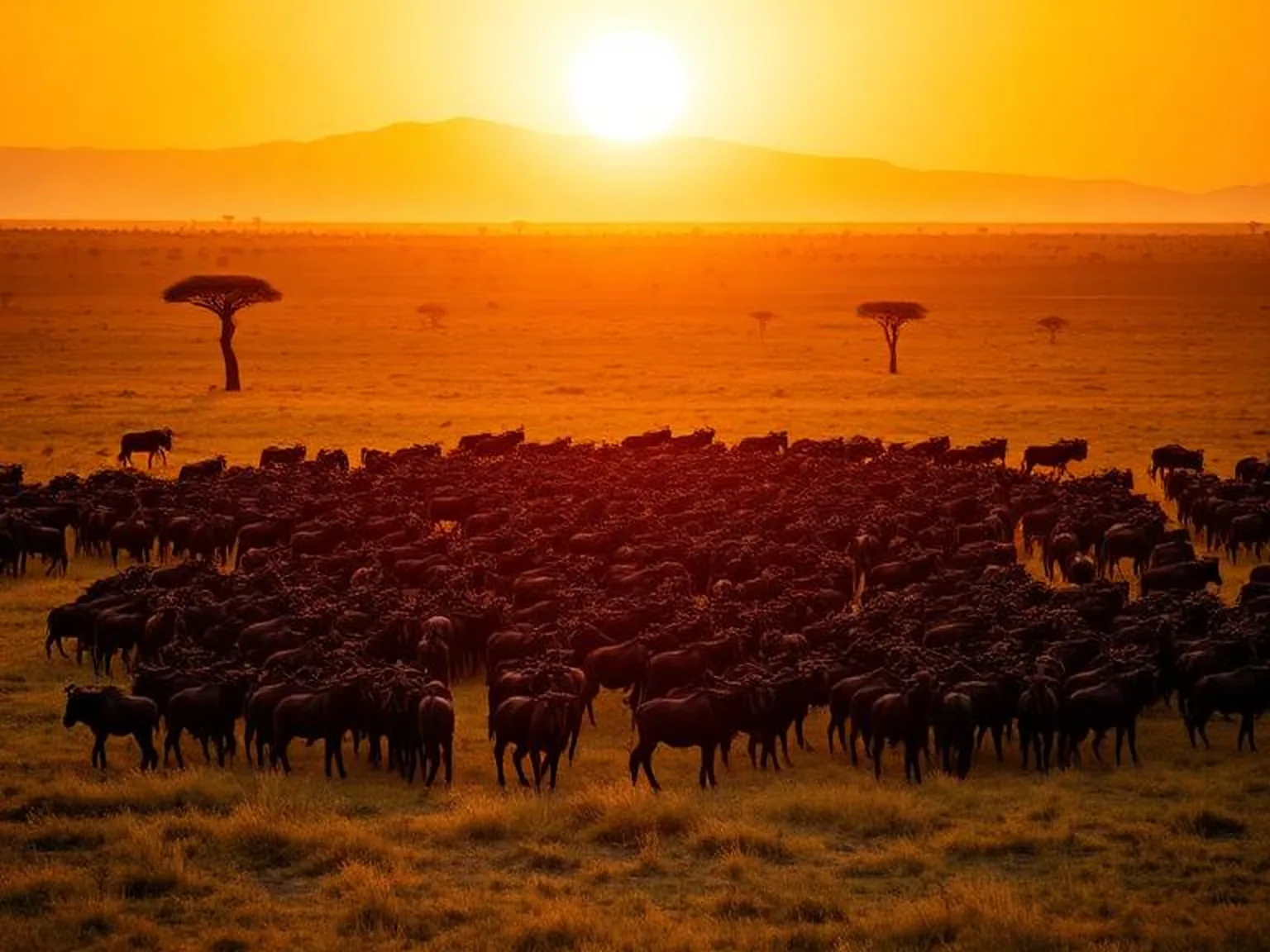
There is a sound the plains make before you see anything at all — a low, restless murmur of hooves and grunts that rolls across the grass for miles. It belongs to more than a million animals on the move, and right now, somewhere on the border between Tanzania and Kenya, they are gathering for the crossing. The Great Migration is coming to the Masai Mara, and there is no wildlife spectacle on earth quite like it.
This is the safari almost everyone pictures when they picture Africa: golden grass to the horizon, acacia trees in silhouette, lions in the long grass, and the heart-stopping moment when the herds plunge into a crocodile-filled river. Kenya’s Masai Mara is the stage for the most dramatic act of that journey, and the season is just beginning. The front-runners reach the Mara from mid-to-late July, and the famous river crossings peak through August and September.
Which makes now the moment to plan. And as with any trip into wild, remote country, it pays to understand one thing before you go: where your phone will work, and where the bush takes over.
Why now — the migration is on its way
The Great Migration is not an event so much as a year-round, circular journey. Around 1.5 million wildebeest, joined by some 400,000 zebra and 200,000 gazelle, move in a vast loop across the Serengeti–Mara ecosystem, following the rains and the fresh grass. From January they calve on the southern Serengeti plains; through the middle of the year they push north and west; and from around July they funnel into Kenya’s Masai Mara, where the Mara River stands between them and the green grass beyond.
That river is the whole drama. The herds mass on the banks, hesitate, and then — triggered by nothing anyone can predict — pour across in a churning, desperate rush while crocodiles wait below. It is raw and it is unforgettable, and it is gloriously unscheduled: a crossing might happen four times in a day or not for three days running. The crossings are most likely in August and September, but the only reliable way to see one is patience, so plan to stay several nights near the river corridor. One consequence of all this: the best camps sell out six to eighteen months ahead for the peak weeks, so the earlier you plan, the better your options.
The Masai Mara
Even without the migration, the Mara would be one of the great safari destinations. This is big-cat country — among the finest places on the planet to see lions, and a reliable home for cheetah and leopard too — set across open, rolling grassland that makes the wildlife easy to spot and the light, at dawn and dusk, unreal. The full cast is here: elephant, buffalo, giraffe, hippo, hyena, and plains game in their thousands.
It helps to understand how the area is organised, because it shapes your trip. The Masai Mara National Reserve is the main protected area, home to the famous river crossing points — and at a big sighting in peak season, you may share the moment with a crowd of vehicles. Ringing the reserve are the private conservancies — Mara North, Olare Motorogi, Naboisho, Ol Kinyei and others — Maasai-owned lands where vehicle numbers are capped and where you can do what the main reserve doesn’t allow: drive off-road to a sighting, head out on a night game drive, or walk the bush on foot with an armed guide. A stay that combines a night or two in the reserve for the crossings with time in a conservancy for the intimacy is, for many, the ideal.
For a different perspective entirely, drift over the herds at dawn in a hot-air balloon, traditionally followed by a champagne breakfast on the plains — one of those splurges that earns its reputation.
Beyond the Mara — Kenya’s wider safari circuit
The Mara is the headline, but Kenya rewards anyone who strings together a longer trip. Amboseli, in the south, is famous for its great elephant herds set against the snow-capped backdrop of Mount Kilimanjaro across the Tanzanian border — one of Africa’s iconic views. Lake Nakuru in the Rift Valley draws flocks of flamingos and shelters both black and white rhino. Samburu, in the arid north, offers a cast of species you won’t see in the Mara, from Grévy’s zebra to the reticulated giraffe and the long-necked gerenuk. And most trips begin in Nairobi, where you can stand in a national park with the city skyline behind you, or visit the famous elephant orphanage before you ever leave town.
There’s more for those with time. Tsavo, vast and red-earthed, is home to Kenya’s famous dust-bathed “red elephants”; Lake Naivasha makes an easy Rift Valley stop, where a boat ride and a walk on Crescent Island put you on foot among giraffe and zebra with no predators around. And many travellers end a safari on the coast — the white sand and warm Indian Ocean at Diani or Watamu — for the classic “bush and beach” finish. As a rough guide, a week lets you pair the Mara with one other park; ten days or more lets you build the fuller circuit without rushing from one airstrip to the next.
The people of the land
The Mara takes its name from the Maasai, the semi-nomadic people whose lands these are and who lease much of the conservancy territory that protects the wildlife today. Many camps offer visits to a Maasai village or walks with Maasai guides whose knowledge of the bush is unmatched. Approached with genuine respect and through your camp rather than a roadside hustle, it adds a human depth to the trip that the animals alone cannot — a reminder that this landscape is lived in, not just looked at.
Where the signal ends — staying connected on safari
Here is the honest version, because it makes packing and planning easier. Kenya is one of the better-connected countries in the region. Nairobi and the towns have strong, reliable 4G, with 5G growing. In the Masai Mara itself, the strongest local network reaches most camps and the main tracks, and a growing number of lodges offer Wi-Fi in their common areas — increasingly via satellite internet, which has transformed connectivity at remote camps. For the practical business of a safari — navigating between parks, loading your bookings, messaging your guide, sharing the day’s photos over dinner — you’ll usually have a connection.
And then you won’t. Out on a game drive, deep in the reserve, or near the Tanzanian border, signal turns patchy and often vanishes altogether. This is normal, it is expected, and it is the reason camps and guides carry satellite phones for emergencies — you are never truly cut off, even where your own phone is. No SIM or eSIM changes the physics of it; the towers simply aren’t out in the bush.
So the strategy is two-part. For the connected stretches, set up an IbiPoint Kenya eSIM before you leave home. It installs in seconds, connects to local networks the moment you touch down in Nairobi, and skips both the airport SIM counter and the roaming bill. A fixed Data Pack works well if you want a simple bucket of data; an Unlimited Flex plan gives you a daily high-speed allowance and then keeps you online at reduced speed rather than cutting you off — handy when you’re leaning on maps and messaging. If your trip also crosses into Tanzania or Uganda, a regional Africa plan may be the better fit. For everything else, prepare: download offline maps before each drive, and treat the disconnected hours as the point of being there.
What to know before you go
Sort your entry permit first. Kenya replaced visas with an Electronic Travel Authorisation (eTA) in 2024. Almost every visitor, children included, needs an approved eTA before boarding — there is no visa-on-arrival. Apply only at the official portal, etakenya.go.ke, ideally a couple of weeks ahead; the fee is around USD 30 and it’s valid for 90 days from issue. If your trip also takes in Uganda and Rwanda, the East Africa Tourist Visa covers all three.
See a travel clinic. Much of Kenya, including the Mara, is a malaria area, so talk to a travel-health professional about antimalarials well before you go, and check whether you’ll need a yellow-fever certificate based on your route. This is standard safari preparation, not cause for alarm.
Pack for the bush and the cold. Neutral colours (avoid bright white and dark blue), warm layers for the genuinely cold dawn game drives, sun protection for the rest of the day, binoculars, and a good power bank — game drives can run eight to ten hours away from a socket, and you’ll want the battery for the camera.
Carry some cash, and book early. The currency is the Kenyan shilling; lodges and city establishments take cards, but tips, markets and small purchases run on cash. And it bears repeating — for the migration season, the camps that put you closest to the action are reserved many months ahead.
Get connected before you fly. Set up your eSIM at home so navigation and messaging are live the moment you land in Nairobi, rather than something to arrange in the arrivals hall.
The safari state of mind
Something shifts on a good safari. The days reorganise themselves around the light — out before dawn when the air is cold and the predators are still moving, back to camp through the heat of midday, out again as the sun drops and the plains turn gold. You stop checking your phone, partly because there’s no signal and partly because there’s a leopard in the tree. You learn to sit still and wait, and the waiting becomes the point. And then the herds reach the river, and a hundred thousand animals decide, all at once, to run — and you understand why people cross the world for this.
Kenya is not a trip you rush. It asks you to slow down, to look harder, and to let the wild set the pace. Plan it early, stay connected where the networks reach, carry your offline maps where they don’t — and go while the great herds are on the move.
Planning a Masai Mara safari? Talk to IbiPoint Support — we’ll help you pick the right plan for the connected parts of your journey.