
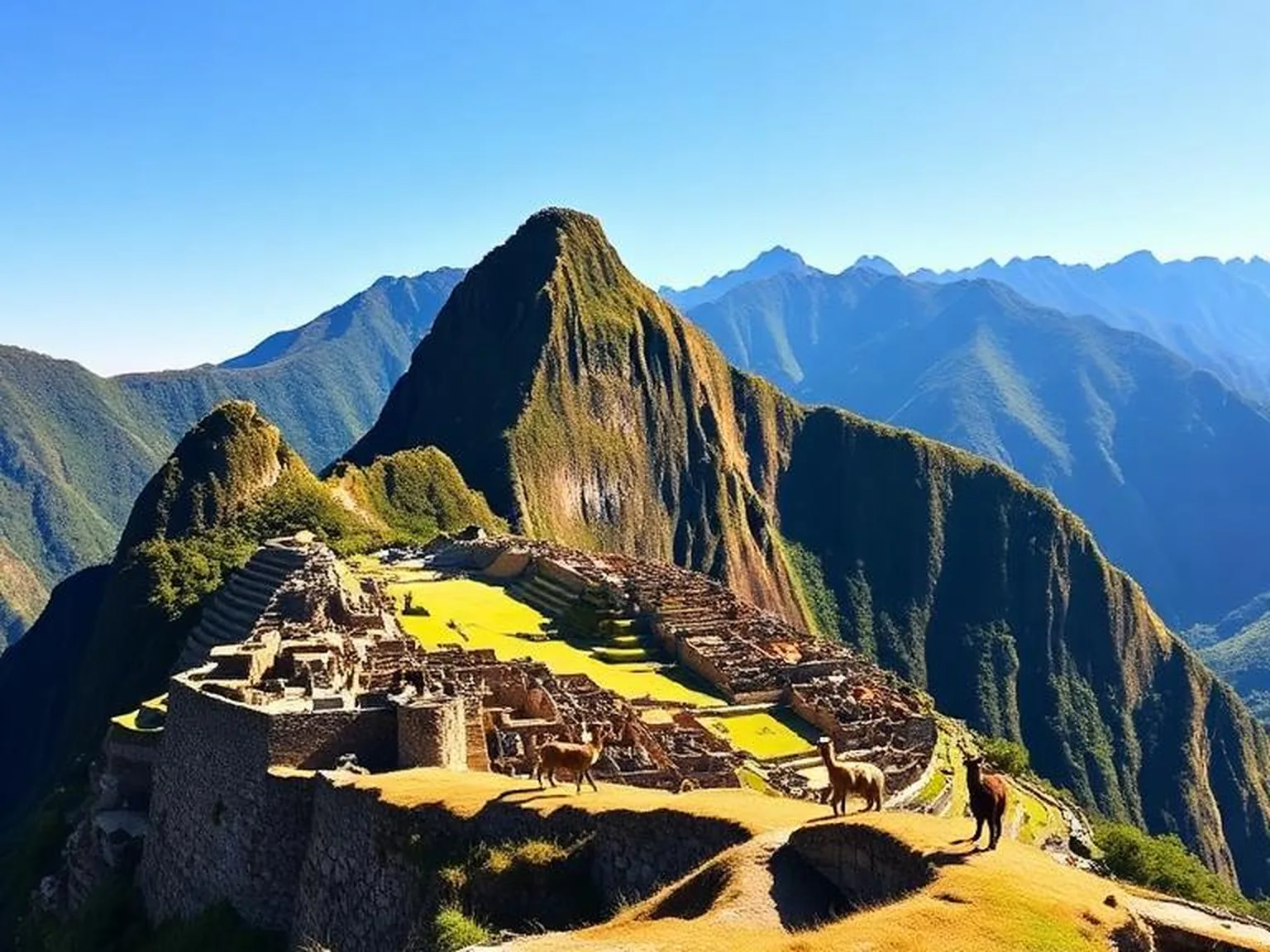
Some trips sit near the top of almost everyone’s list, and Peru is one of them. The image is fixed in the mind before you ever go: green terraces falling away into cloud, a lost stone city on a ridge, a llama grazing where an empire once stood. What the postcard never tells you is how much more there is around it — a living Andean culture, one of the great food countries on earth, markets and ruins and festivals stacked one on top of another, all set in mountains that take your breath away in both senses of the phrase.
And right now is the moment to go. The southern winter — June through August — is Peru’s dry season, when the Andean skies clear, the trekking is at its finest, and the high country is at its most welcoming. It is also festival season: this week, on Wednesday 24 June, Cusco stages Inti Raymi, the Festival of the Sun, the biggest celebration in the Andes. There is no better time to be in the old Inca capital.
There is one thing worth understanding before you go, the same thing that shapes any trip into high, remote country: where your phone will work, and where it won’t.
Why now — the dry season and the Festival of the Sun
Peru’s seasons are flipped from the northern hemisphere. The winter months of June, July, and August are dry and bright across the Andes — cold, clear nights, strong daytime sun, and the most dependable weather of the year for hiking and for visiting Machu Picchu without it vanishing into cloud. This is peak season, with the crowds and prices to match, but the trade is worth it: the trails are open and in top condition, and the views are at their sharpest.
It is also the heart of the festival calendar. Inti Raymi, the Festival of the Sun, falls on 24 June every year, coinciding with the southern winter solstice — the day the Inca asked the sun to return. The modern reenactment, performed in Quechua by hundreds of costumed actors, moves through the city across the day: it begins at the Qorikancha, the old Temple of the Sun, continues to the Plaza de Armas, and culminates in the afternoon at the vast fortress of Sacsayhuamán above the city, where tens of thousands gather on the esplanade. It is loud, colourful, and genuinely moving — and it makes this the busiest week of the year in Cusco. If you are reading this in time, you are reading it during the festival.
Cusco — the heart of it all
Almost every Peru trip runs through Cusco, the former capital of the Inca Empire and the gateway to everything around it. The city is a layered thing: Inca stonework at the base of Spanish colonial walls, baroque churches built on temple foundations, a beautiful central Plaza de Armas ringed by arcades and cathedrals, and the steep artist’s quarter of San Blas climbing the hillside above. Spend your first days here wandering — the Qorikancha, the San Pedro market, the great walls of Sacsayhuamán just above town — and let the city work on you.
One thing Cusco demands is respect for its altitude. At around 3,350 metres, it is high enough that many arrivals feel the effects — headaches, breathlessness, fatigue, the local soroche. Give yourself at least two days before any hard hiking. Take the first day slow, skip the alcohol, drink water and the ubiquitous coca tea, and eat lightly. Your body adjusts, but only if you let it.
The Sacred Valley
Between Cusco and Machu Picchu lies the Sacred Valley of the Incas, and it deserves far more than the drive-through most itineraries give it. The valley floor sits lower than Cusco, which makes it the smart place to spend your first couple of nights while you acclimatise. It is also extraordinary in its own right.
Pisac has a hilltop fortress of terraces and temples above a famous artisan market. Ollantaytambo is a living Inca town, its original grid still walked daily, crowned by a steep ceremonial site and the departure point for the train to Machu Picchu. Between them lie the surreal salt terraces of Maras — thousands of shallow pans worked since Inca times — and the circular agricultural terraces of Moray, an open-air laboratory the Inca used to test crops at different microclimates. Two or three days here, moving slowly between villages and ruins, is one of the quiet pleasures of a Peru trip.
Machu Picchu — and how to actually get in
And then the citadel itself. Nothing quite prepares you for the first sight of Machu Picchu over the ridge — the terraces, the temples, the impossible setting between green peaks. It earns every word of its reputation. What has changed in recent years is how you access it, and it pays to understand the system before you book.
Machu Picchu now runs on timed-entry tickets with assigned circuits — designated routes through the site that you choose when you book and must stick to, with rangers checking along the way. Capacity is capped and peak dates sell out, so reserve your ticket well ahead, ideally a couple of months out, and earlier still if you want one of the limited Huayna Picchu mountain climbs. Most travellers reach the site by train to Aguas Calientes, the town below, then a short bus up to the gate.
The other way in is on foot, via the Classic 4-day Inca Trail — the great pilgrimage hike that arrives through the Sun Gate at dawn. It is unforgettable, and it is tightly controlled: just 500 permits a day including guides and porters, bookable only through a government-licensed operator, tied to your passport, non-refundable, and closed every February for maintenance. Peak-season permits sell out many months in advance, so this is a trip you plan around, not into. If the Inca Trail is full, the Salkantay and Lares treks reach Machu Picchu by other routes without the same permit cap, and both are spectacular in their own right.
Beyond the headline sights
Peru rewards anyone who stays longer than the Cusco–Machu Picchu loop. The candy-striped slopes of Rainbow Mountain and the turquoise Humantay Lake are demanding high-altitude day hikes from Cusco. South lies Lake Titicaca and the reed islands of the Uros around Puno. Further on, the white city of Arequipa sits beneath volcanoes, gateway to the condor-filled depths of the Colca Canyon. Down on the coast, Lima has quietly become one of the world’s great food cities. And east, the land drops into the Amazon, a different Peru entirely. Most people come for Machu Picchu and leave plotting a return for everything else.
Where the signal ends — staying connected at altitude
Here is the honest version, because it makes the trip easier to plan. Peru’s mobile coverage is genuinely good across the places you spend most of your time. Lima, Cusco, Arequipa and the Sacred Valley towns have reliable 4G, with some 5G in the cities. Aguas Calientes, the town below Machu Picchu, is well covered. For the great majority of this trip — navigating, booking, translating, hailing a ride, loading your tickets, keeping your group together in the Inti Raymi crowds — you will have a strong connection.
And then there are the places you won’t. Signal at the Machu Picchu citadel itself is intermittent — enough for the occasional photo, not for anything live. On the Inca Trail and the high mountains — Rainbow Mountain, Humantay, the remote passes — there is little to no coverage from any network, which is exactly why trekking guides carry satellite phones for emergencies. No eSIM or local SIM changes this; the towers simply aren’t out there.
So the strategy is two-part. For the connected majority of the trip, set up an IbiPoint Peru eSIM before you leave home. It installs in seconds, activates the moment you land on local networks, and skips both the airport SIM counter and the roaming bill. Choose a fixed Data Pack if you like a simple bucket of data, or an Unlimited Flex plan that gives you a daily high-speed allowance and then keeps you online at reduced speed rather than cutting you off. For the disconnected rest, prepare: download offline maps of Cusco, the Sacred Valley and your trek before you set out, and treat the trail’s silence as the gift it is.
What to eat
Peru is, by serious consensus, one of the best eating countries on the planet, and the food alone justifies the trip. On the coast, ceviche — raw fish “cooked” in lime juice with chilli, onion and corn — is the national pride, and Lima’s restaurants regularly rank among the world’s finest. Inland and everywhere, lomo saltado (stir-fried beef with onions, tomato and chips, a Chinese-Peruvian classic) and ají de gallina (creamy chilli chicken) are the comfort staples.
In the Andes, the food turns ancient and hearty: hundreds of varieties of potato, quinoa, giant-kernelled choclo corn, and anticuchos — skewered, grilled beef heart — sizzling at street stalls. The brave try cuy, roast guinea pig, a genuine Andean delicacy served on special occasions. Wash it down with chicha morada, the sweet purple-corn drink, and end with a pisco sour, the frothy grape-brandy cocktail that is Peru’s gift to the bar. You can eat brilliantly here at every price point, from a market stall to a tasting menu.
Practical tips for the trip
Acclimatise before you exert. Altitude is the single most common thing that derails a Peru trip — arrive, slow down, hydrate, and give yourself a couple of days in Cusco or the lower Sacred Valley before any big hike. Coca tea genuinely helps; alcohol on day one genuinely doesn’t.
Book the big-ticket items early. Machu Picchu tickets, Inca Trail permits, and Cusco hotels around Inti Raymi all sell out months ahead, and June is the busiest month of all. This is a trip to lock in well before you fly, not to improvise on arrival.
Pack for two climates in one day. The Andean sun is fierce at altitude — hat, sunglasses, high-factor sunscreen — while evenings turn sharply cold. Layers are the answer, every day.
Carry some cash, and check the paperwork. The currency is the sol; cards work in cities and hotels, but markets, small towns, and tips run on cash. Most Western travellers visit Peru visa-free for tourism — confirm your country’s allowance before you go — and it is always worth checking your government’s current travel advice when booking.
Get connected before you fly. Peru runs on apps the moment you land — maps, rideshare, translation, ticket wallets. Set up your eSIM so it’s all working as you step off the plane in Lima or Cusco, not something you’re arranging in the arrivals hall.
The Peru state of mind
There is a particular rhythm this trip falls into. You sip coca tea in a courtyard at 3,000 metres while your body catches up with the air. You walk a stone street the Inca laid five centuries ago and a grandmother sells you the best corn you’ve ever eaten. You stand on a terrace at Machu Picchu as the cloud lifts off the ridge, and for a moment the whole place feels less like a ruin than a city waiting for its people to come home. You watch the sun honoured in a language older than any country, and you understand why they bothered.
Peru is not a quick or an easy trip. It is high, it is far, and it asks you to slow down and let it unfold. That is exactly what makes it one of the great ones. Stay connected where the networks reach. Carry your offline maps where they don’t. And go in the dry season, while the skies are clear and the sun is being welcomed home.
Planning a trip to Cusco and Machu Picchu? Talk to IbiPoint Support — we’ll help you pick the right plan for the connected parts of your journey.