
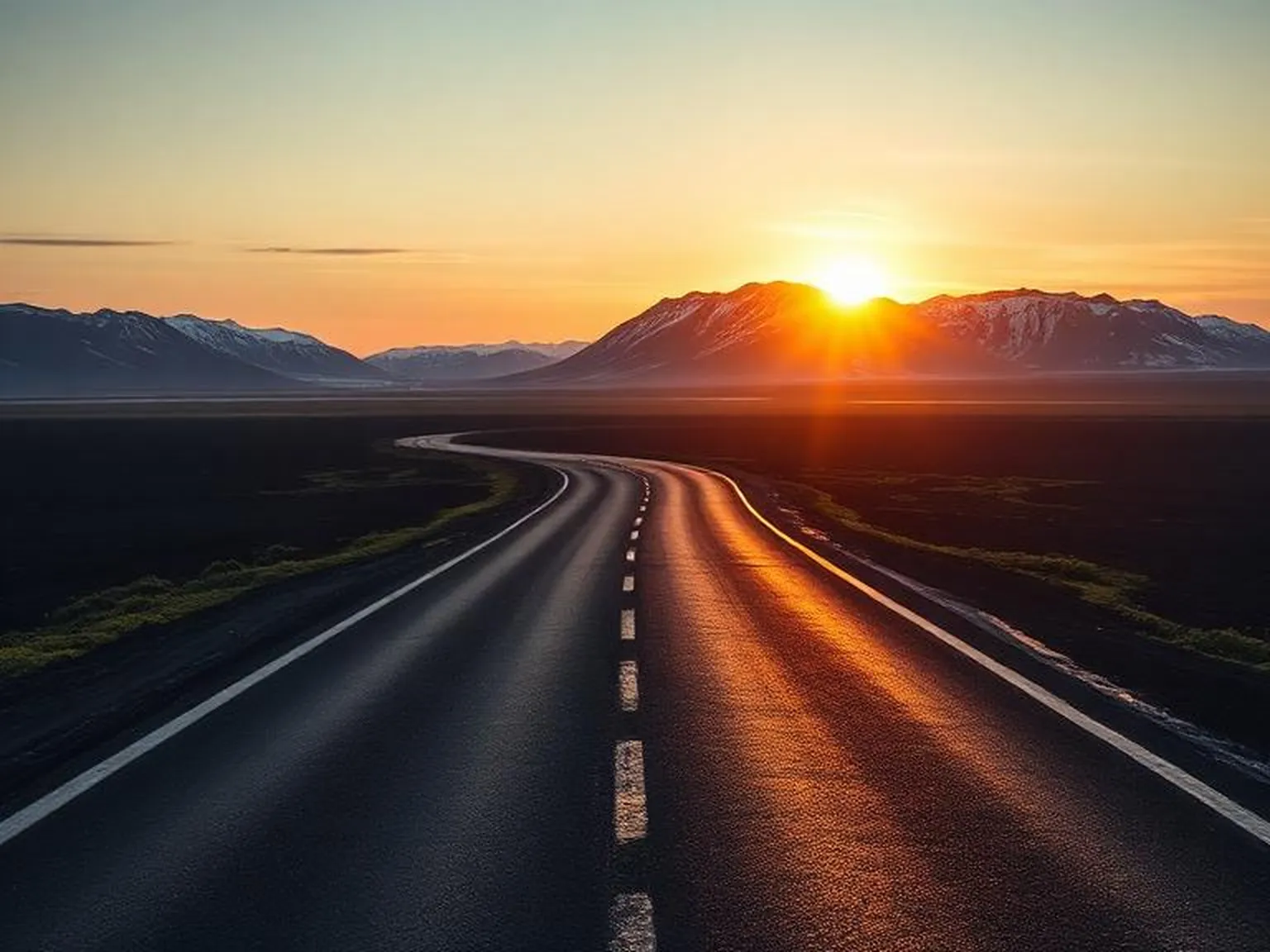
There is a moment, somewhere around midnight on your second day in Iceland, when you realise the sun is not going to set. You have driven for hours through a landscape that looks like the surface of another planet — black lava fields, neon-green moss, glaciers hanging off the edges of mountains — and the light has barely changed. It is gold and low and endless. You could keep driving forever. Some people, briefly, do.
This is the Iceland summer trip, and it is unlike anything else on the travel map. One island, one road, and a sun that hangs just above the horizon for weeks on end. The Ring Road — Route 1 — loops the entire country in roughly 1,300 kilometres of clean paved highway, and in the midnight-sun months of June, July, and August it is open end to end, snow-free, and bathed in light for around twenty-one hours a day. You do not race this trip. You let the daylight stretch it out until your sense of time quietly dissolves.
Iceland has become one of the most photographed countries on earth, and it has earned every frame. But there is one part of the trip that the photographs never show, and that has historically caught travellers out: knowing where you will have a signal, where you will not, and how to stay safe in a place where the weather and the roads can turn in an hour. That part has a clean solution now, and we will come back to it.
The route, in one sentence
Iceland’s Ring Road circles the island clockwise or counter-clockwise from Reykjavik, through the Golden Circle, the South Coast, the glacier lagoons of the southeast, the fjords and lava fields of the east and north, and back along the west — roughly 1,300 kilometres, seven days comfortable, ten days ideal, two weeks if you add the Westfjords or the Snaefellsnes peninsula. Almost all of it is paved Route 1, drivable in a normal car in summer. The only places you need a 4×4 are the interior highland tracks, the F-roads, which open through June and are a trip of their own.
There are three honest shapes to this trip, and the right one depends entirely on how much time you have. The full loop is the classic. The no-car version — a Reykjavik base with day trips — is the answer for a long weekend or for travellers who would rather not drive. And the slow version trades the full circle for the South Coast and the highlands, going deep instead of wide. We will walk through all three, because all three are worth doing.
Why this trip, why now
Three things make a summer Iceland trip better than it has ever been. The first is the daylight. Around the solstice on 21 June, the sun rises in Reykjavik just before three in the morning and does not set until just after midnight — and even in the brief dip below the horizon, the sky never goes truly dark. From late May to late July you get a soft, golden, around-the-clock light that turns ordinary photographs into extraordinary ones and lets you drive, hike, and explore on whatever schedule suits you. The waterfalls at 11 p.m. are empty. The light at 1 a.m. is the best of the day.
The second is access. The highland interior — the wild, roadless heart of the country — is sealed by snow for most of the year. Through June it opens. The F-road to Landmannalaugar, the most beloved of the highland routes, typically opens somewhere between the tenth and the twentieth of June; the remote desert crossings open later, into early July. By midsummer the whole country is reachable. This is the only window in which the full Iceland exists, and it is short.
The third is everything that has been built since the last tourism boom. The Ring Road is smoother. The town infrastructure is better. The food scene in Reykjavik has matured from “fish and lamb” into one of the more interesting small-city dining cultures in Europe. And the mobile networks now blanket the populated coast and most of Route 1 with strong 4G and growing 5G — which solves most, though crucially not all, of the connectivity problem that used to define a trip like this.
The no-car version — Reykjavik and the Golden Circle
If you have three or four days, do not attempt the loop. Base yourself in Reykjavik and let the day trips come to you. The capital is the northernmost in the world and one of the most walkable small cities anywhere — Hallgrimskirkja church on the hill, the harbour and the Harpa concert hall, the cafes and record shops and wool sweaters of Laugavegur, and a food scene that rewards two or three good dinners. Add the geothermal swimming culture: the Blue Lagoon is the famous one, but the newer Sky Lagoon and the city’s own neighbourhood thermal pools are where Icelanders actually go.
The Golden Circle is the day trip everyone does and everyone should. Thingvellir National Park, where the North American and Eurasian tectonic plates pull visibly apart and where Iceland’s parliament was founded over a thousand years ago. The Geysir geothermal area, where Strokkur erupts a column of boiling water every few minutes. And Gullfoss, the “golden waterfall,” a two-tier torrent that disappears into a canyon in a permanent cloud of spray. The whole circle is a comfortable day by car or organised tour, and it works year-round.
From the same base you can reach the South Coast’s first highlights — the waterfalls and black-sand beaches an hour or two east — as a long day trip. It is not the full country, but it is a genuine taste of it, and for many travellers it is the start of a return relationship rather than a one-off.
The South Coast — the slow road
The stretch of Route 1 running east from Reykjavik is the most concentrated scenery in Iceland, and it is where the slow version of the trip earns its name. Within two hours you reach Seljalandsfoss, the waterfall you can walk behind, and Skogafoss, a wall of water sixty metres high that throws rainbows on every sunny afternoon. Beyond them lies Reynisfjara, the black-sand beach near Vik with its basalt columns and its genuinely dangerous sneaker waves — beautiful, photogenic, and to be treated with respect.
Further east the landscape opens into the great glaciers. Jokulsarlon, the glacier lagoon, is the single most arresting sight on the South Coast — icebergs calving off the Vatnajokull glacier and drifting slowly out to sea, while across the road the same ice washes back onto the black sand of Diamond Beach and glitters in the midnight light. Most travellers rush this part on a single drive. The slow version gives it two or three days, with hikes onto the glacier tongues and a night near the lagoon to watch the ice move.
The slow road is the right call if you would rather know one part of Iceland well than glimpse all of it. You will not complete the circle. You will not feel you missed anything.
The full loop — east, north, and west
Commit to the whole Ring Road and the country keeps unfolding past the South Coast. The Eastfjords are Iceland at its quietest — narrow roads hugging the water, fishing villages with a few dozen houses, reindeer on the hillsides, and almost no other travellers. The pace here is the gentlest of the entire loop.
The north is the dramatic counterweight. The Myvatn lake area is a geothermal wonderland of bubbling mud pots, steaming vents, and the Namafjall sulphur fields, with the thundering Dettifoss — the most powerful waterfall in Europe — a short detour away. Akureyri, the unofficial capital of the north, is a proper small town with good restaurants and a cathedral, and a fine place to break the drive for a night.
The west closes the circle. If you have the time, the detour onto the Snaefellsnes peninsula is the loop’s best decision — a miniature of all of Iceland in one afternoon’s drive, crowned by Kirkjufell, the arrowhead mountain that is the single most photographed peak in the country. From there it is a short run back to Reykjavik, the circle complete, the odometer somewhere north of 1,500 kilometres, and the light still refusing to fade.
Into the highlands
The interior is the Iceland that most visitors never see, and in summer it is finally reachable. The highland F-roads are unpaved mountain tracks that cut through the roadless centre of the country — past steaming geothermal fields, across glacial rivers, into landscapes so barren that NASA once trained astronauts there. They are spectacular, and they are not to be taken lightly.
Landmannalaugar is the gateway. Its rhyolite mountains glow in bands of red, orange, and green, and a natural hot spring sits at the trailhead of some of the best hiking in the country. The F-road in typically opens between the tenth and the twentieth of June; the remoter routes, like the great Sprengisandur desert crossing, open later, into early July. A four-wheel-drive vehicle is a legal requirement, river crossings are real and sometimes serious, and the weather can change in minutes.
Two rules matter more than any other in the highlands. First, it is strictly illegal to drive on a road still marked closed, and doing so tears scars into the thawing volcanic soil that take decades to heal — so check road.is before every single leg, and turn back if the gate is shut. Second, this is where Iceland’s connectivity runs out completely, which brings us to the part of the trip that needs saying plainly.
Where the signal ends — connectivity and safety
Here is the honest version, because the honest version is the useful one. Iceland’s mobile coverage is genuinely good across the parts of the country where you spend most of your time. Reykjavik and the larger towns have fast 4G and 5G. The Ring Road and the popular routes — the Golden Circle, the South Coast, Snaefellsnes — are well covered at most points. For the great majority of this trip, you will have a strong, fast connection.
And then there are the places where you will not. The highland interior has effectively no signal from any network — the towers simply do not exist out there. The Westfjords, parts of the Eastfjords, and the long empty middles of some Ring Road sections have real dead zones where you can drive for an hour or more with nothing. No eSIM, no local SIM, no provider on earth changes this. Anyone who tells you their plan gives you signal in the centre of Iceland is selling you something.
So the right strategy is two-part. For the connected 90 percent of the trip, use a proper data plan — and the cleanest way to get one is an eSIM you activate before you leave home, so you are online the moment you land at Keflavik rather than hunting for an airport kiosk that charges tourists several times the local rate. An IbiPoint Iceland eSIM rides the country’s local 4G and 5G networks, supports tethering so you can run a laptop or a second device, and can be topped up if you stay longer. There are 77 Iceland plans, from small data packs for a short city break to long-validity options for a full summer, starting from around a dollar. You install it in seconds and never touch a SIM card.
For the disconnected rest, you prepare. Download offline maps of your whole route before you set out. Register your travel plans at safetravel.is, the official Icelandic travel-safety service. Install the free 112 Iceland app, which sends your GPS location to rescuers and works on the faintest signal — it is the single most important thing on your phone in the highlands. And get into the habit, every morning, of checking road.is for road status and vedur.is for weather while you still have a connection. The eSIM handles the connected world. These tools handle the gaps.
IbiPoint covers 200+ countries on the same account and the same app, so the Iceland plan you buy for this trip is the start of a single travel-data setup rather than a one-off. But for Iceland specifically, the point is simpler: stay connected where it counts, and be properly prepared where nothing connects.
What to eat across the island
Iceland’s food has quietly become one of the more interesting stories in northern European cooking, built on a small set of superb raw ingredients and a national obsession with freshness. It is also, fair warning, expensive — but you eat very well.
The lamb is the national treasure. Icelandic sheep graze wild on herbs and grasses all summer, and the meat is lean, clean, and faintly herbal in a way no farmed lamb matches. Kjotsupa, the traditional lamb-and-vegetable soup, is the comfort dish of the whole country and the best thing to eat after a cold day outdoors. The seafood is the equal of the lamb — langoustine from the south coast, cod and haddock straight off the boats, and an Arctic char that turns up on the best Reykjavik menus.
Skyr, the thick cultured dairy that sits somewhere between yoghurt and soft cheese, is the everyday staple — eat it for breakfast with berries. The dark, dense rye bread, sometimes baked slowly in the ground using geothermal heat, is worth seeking out. And the great democratic Icelandic meal is the pylsa, the lamb-and-pork hot dog with crispy onions and a sweet-brown mustard, sold from stands across the country and beloved by everyone from truck drivers to prime ministers. The fermented shark, hakarl, exists mostly so that you can say you tried it; one bite is plenty, and the locals will respect you more for the honesty than the bravado.
The money-saving move is real and worth stating: groceries are far cheaper than restaurants, so a campervan trip or a guesthouse with a kitchen lets you cook breakfasts and packed lunches and save the restaurant budget for a few proper dinners. And the tap water is among the best on the planet — straight off the glaciers, completely free everywhere — so never, ever buy it bottled.
Practical tips for the Ring Road
Watch the weather and respect it. Iceland’s weather changes faster than almost anywhere, and a calm morning can become a sideways-rain afternoon with wind strong enough to rip a car door off its hinges — a genuinely common and expensive insurance claim. Dress in layers, always carry a waterproof shell, and check vedur.is daily. The summer temperatures are mild, often 10–15°C, occasionally less; this is not a beach holiday and you will want a warm layer even in July.
Drive carefully and legally. Route 1 is easy, but watch for single-lane bridges, blind summits, loose gravel where the pavement ends, and the occasional sheep in the road. Off-road driving is completely illegal everywhere in Iceland and causes lasting damage to fragile terrain — stay on marked roads and tracks without exception. For the F-roads, you need a 4×4, you need to check road.is, and you should never attempt a river crossing you are not confident about.
Budget honestly. Iceland is expensive, and the big costs are the car, the fuel, and the accommodation. A campervan is the classic way to fold transport and lodging into one expense. Book the car and the lodging well ahead for the summer months, when both sell out. The country is almost entirely cashless — a card works for everything, from the smallest petrol station to the hot-dog stand — so you barely need to carry cash at all.
Sort your entry documents. Iceland is part of the Schengen area, and most visa-exempt travellers — including UK, US, Canadian, Australian, and many other passport holders — can visit for up to 90 days without a visa. A new European travel authorisation, ETIAS, is expected to launch toward the end of 2026; it is not yet in force, but it is worth checking your country’s current entry requirements a week before you fly, as the rules are changing.
Sleep through the light. The midnight sun is wonderful and it will wreck your sleep if you let it. Most accommodation has blackout curtains; bring a good eye mask as backup. And get connected before you fly — set up your data so that road.is, vedur.is, the 112 app, your maps, and your bookings are all working from the moment you land, not something you are scrambling to arrange in the arrivals hall.
The Iceland state of mind
There is a particular feeling this trip delivers and no other one quite does. You stand alone at a waterfall at eleven at night in full golden light, and there is not another human in sight. You drive a road that curves toward a mountain with the sun sitting on top of it, and you cannot tell whether it is sunrise or sunset because it is, in a sense, both. You soak in a hot spring while cold rain falls on your face. You eat a bowl of lamb soup in a town of two hundred people and it is the best meal of the week. You lose track of what day it is, and then of what time it is, and somewhere in that loss the trip does its work on you.
Iceland is not a cheap holiday and it is not an easy one to over-plan, because the weather and the roads always have the final say. It is something better than convenient — it is one of the last places in Europe where the landscape is genuinely bigger than you are, where the light does things you have never seen, and where being properly prepared is the price of being properly free. Stay connected where the networks reach. Carry your offline maps and your safety app where they do not. Then let the road and the sun take it from there.
The light is endless. The road is open. Go in summer.
Iceland eSIM Europe regional eSIM
Planning a summer Ring Road trip? Talk to IbiPoint Support — we’ll help you pick the right plan so every town, trailhead, and weather check just works.