
Northern Lights eSIM — chasing the forecast, and the green you won’t see
Almost everything written about the northern lights tells you where to stand. Very little of it tells you the two things that actually decide whether the trip works: that you are not really hunting an aurora, you are hunting a gap in the cloud, and that when you find one, it will not look like the photograph that made you book.
Both of those are good news, once you know them. They just change how you plan.
The forecast is the trip
The aurora itself is the predictable half. Space-weather agencies can see the solar wind coming and put useful odds on the next few hours, sometimes the next few days. The cloud over your head is the part nobody can promise, and it is the part that sends people home having seen nothing on a week when the sky above the cloud was putting on the best show of the season.
Which is why the serious version of this trip is mobile. Tromsø, Abisko and the Finnish Lapland bases sit within a long drive of one another across three countries, and the people who reliably see something are the ones who look at the cloud map after dinner and then move. A bad night in one valley is very often a clear night ninety minutes away.
Abisko has a reputation here worth repeating carefully. Sheltered by the mountains along Torneträsk, it is said to sit in a “blue hole” of persistently clearer sky, and the mechanism is plausible enough — a rain shadow, a lake, a stable westerly. What nobody seems to publish is the hard number: how many more clear nights it actually gets. Treat it as a good bet rather than a guarantee, which is how the locals treat it too.
Europe eSIM plansIs this a good year? Yes — but not for the reason you have read
You will see a lot of copy claiming this is peak solar maximum. It is not. Solar Cycle 25 has passed its peak and the sun is into its declining phase, and a certain amount of aurora marketing has not caught up.
The honest version is more interesting than the marketing one. Big flares do become less frequent after the peak, but two things run the other way. Coronal holes — open patches in the sun’s magnetic field that let the solar wind stream out — become more prominent in the declining phase, and because the sun rotates, the same hole sweeps past Earth roughly every twenty-seven days. That gives you recurring, broadly forecastable activity rather than a lottery. And the very strongest eruptions have a habit of arriving after the peak rather than at it, in the year or two before the cycle bottoms out.
So: fewer events, better odds of a rhythm you can plan around, and no less chance of the one that people still talk about a decade later. If you were waiting for a better year, this is not a worse one.
The green you won’t see
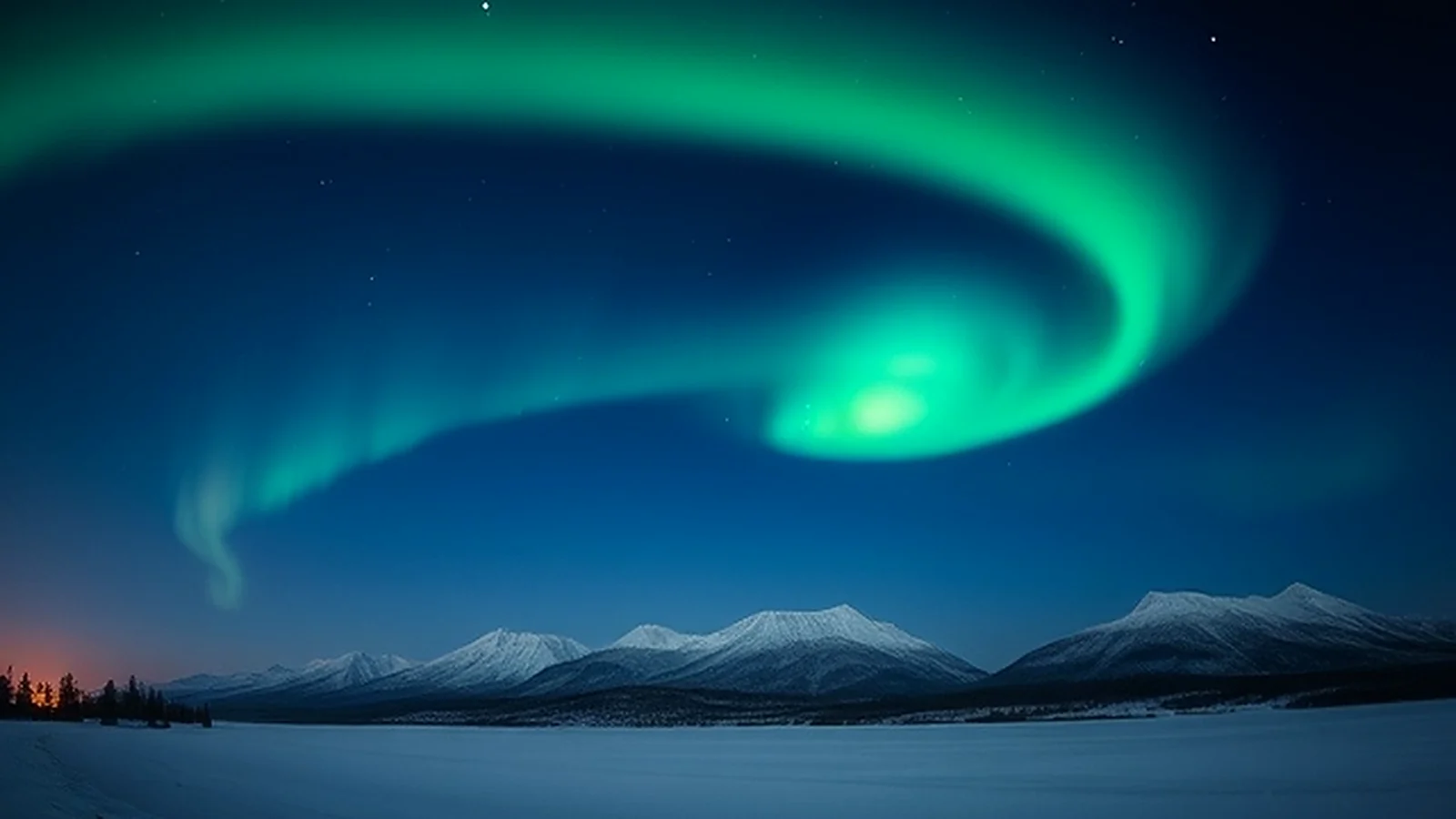
Here is the correction that saves more trips than any tip about tripods. The aurora on your screen is green. The aurora above you will mostly be grey.
The reason is in your eyes rather than in the sky. Colour vision comes from cone cells, which need a decent amount of light to fire. In the dark you switch to rod cells, which are far more sensitive but see only in greyscale. Aurora light usually falls below the threshold where cones engage, so a display that a camera renders in vivid green reads to the naked eye as a pale, shifting grey-white, sometimes with a faint wash of colour at the edges. A camera has no such limit: a long exposure at high ISO gathers what your retina cannot, and shows the green that was genuinely there the whole time.
Strong displays do break through. When the aurora is bright and overhead rather than low on the horizon, colour becomes visible to the eye, and a real storm can go green and red and unmistakable. But the everyday version — the one most visitors get — is monochrome to look at and vivid on the phone, and nobody warns you.
Which is a shame, because knowing it in advance makes the experience better rather than worse. What the photographs cannot capture is the movement: the way a still grey band suddenly runs along its own length, folds, brightens and collapses in seconds. Go expecting the motion rather than the colour, and let the camera handle the colour, which is the one job it does better than you.
Your trip, uninterrupted
This is a trip that runs on a phone more completely than almost any other, because the phone is doing three jobs at once.
It is the forecast: geomagnetic activity, and separately the cloud and satellite maps, checked in the evening and then again at eleven, because both change. It is the navigation, on unlit roads, in winter, often across a border, to a lay-by somebody recommended in a forum. And it is your colour vision — the thing that turns the grey band overhead into the picture you actually came for. A phone that has quietly dropped to no service for the last hour is not a small inconvenience here.
One thing worth getting right, because it is widely misunderstood: Norway is not in the EU, but it is in the EEA, and EU roam-like-at-home covers it, along with Iceland and Liechtenstein. So an EU plan travels across all three countries on this route without a surcharge. What is not covered is Switzerland, and the UK for most plans since Brexit, along with everywhere further afield.
That is the part IbiPoint quietly takes care of. Your eSIM arrives by email in seconds, QR code included, installed before you fly — your regular SIM stays active for calls and texts, and the eSIM carries the trip on fast 4G/LTE and 5G. Because this route crosses borders, the Europe plans are the sane choice: one eSIM that does not care which side of a valley you chased the sky to. Single-country plans exist too if you are staying put in one base. Pick a Data Pack if you know roughly what you use, an Unlimited Flex if you would rather not count, with TopUp whenever you want more and near-real-time Transparency so you always know where you stand.
When to go, and what to accept
The season is set by darkness, not by the aurora, which is there all year and simply invisible under a lit sky. From late September to late March the far north is dark enough, with the deep midwinter weeks offering the longest nights and, often, the worst weather.
The two equinoxes are quietly the sweet spot. Geomagnetic activity runs statistically higher around late September and late March, the cold is survivable rather than punishing, and the roads between your fallback locations are easier to drive at two in the morning. You trade a few hours of darkness for a better chance of using them.
And then the part no guide likes to print. You can read the forecast correctly, drive to the right valley, stand in the cold for three hours and see nothing at all. The only real defence is nights — three or four in a row beats one perfect-looking evening, and the person who books a single night is gambling, not planning. Give it a week if you can, keep the car keys handy, and treat any night you do get as the bonus it is.
So do the boring part now. Order your IbiPoint eSIM tonight and it is ready before you fly, then go north with a working phone, a flexible plan and no expectation of green. The grey is extraordinary on its own, and the green will be waiting on the camera roll in the morning.
Europe eSIM plansPlanning an aurora trip? Talk to IbiPoint support — we’ll help you choose between an Unlimited Flex plan and a single Data Pack for your nights in the north.