
Oktoberfest eSIM — twelve days left, and the bow that means nothing
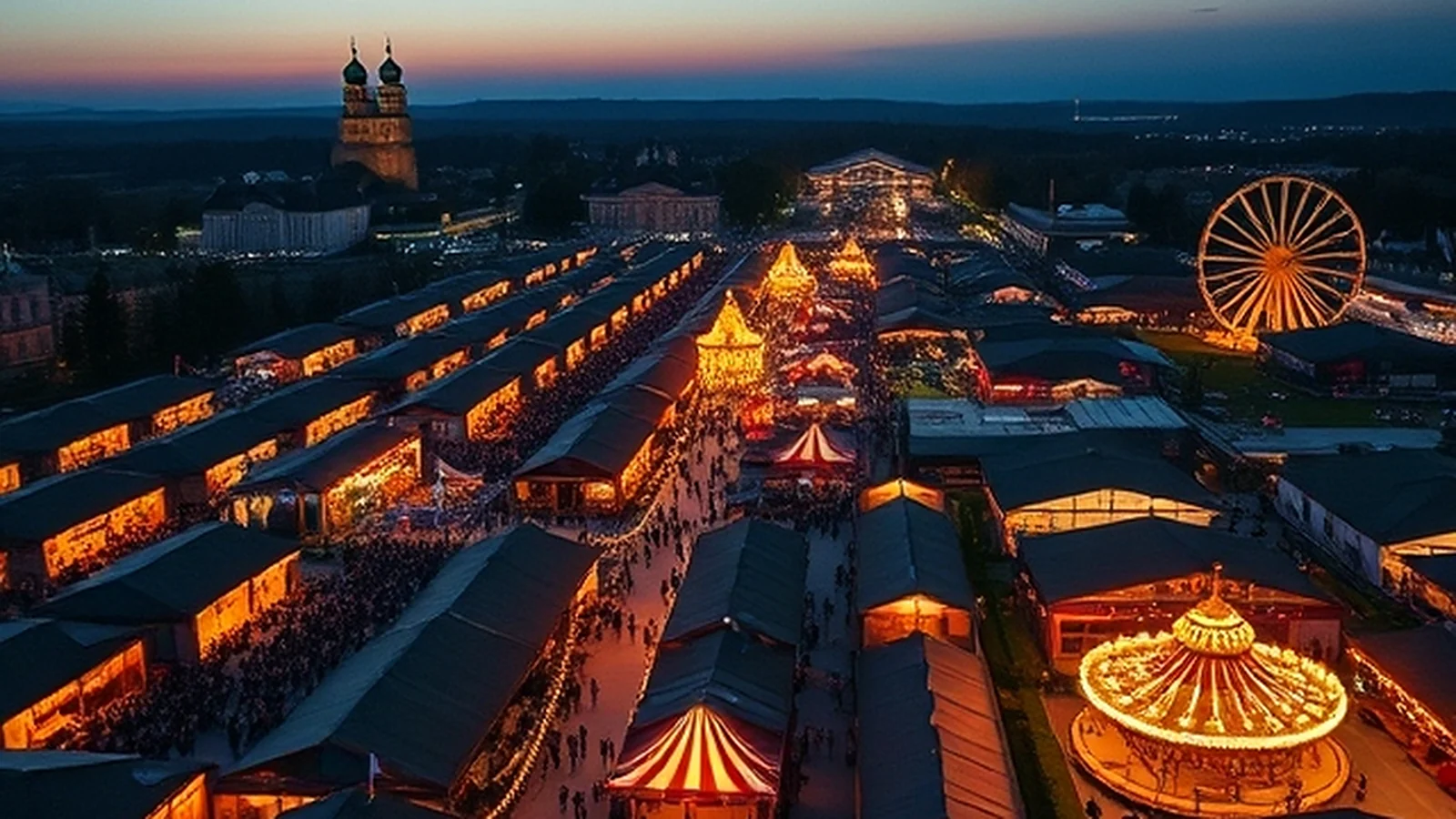
The 191st Oktoberfest opened on Saturday and does not stop until 4 October. By the festival’s own count, roughly 450,000 people walked onto the Theresienwiese on the opening Saturday alone. If you are reading this on Wednesday, twelve days remain.
So this is not a planning piece. The Wiesn is running right now, the tents are filling before lunch, and everything below is about the next twelve days rather than next September — including the one thing almost everybody repeats about the dirndl, which turns out not to be true.
Where it stands, five days in
It opened the way it always opens. At noon on Saturday the mayor drove the tap into the first barrel — two strokes, which is about as well as that goes — said the two words the whole field waits for, and handed the first Maß to the Minister-President. He had, he admitted beforehand, hired a tapping coach. It was his first one in the job. Two strokes is a good answer to that kind of nerves.
The scale is the part nobody quite believes until they stand in it: 38 tents, seventeen of them large, and a fairground wrapped around them. Entry to the grounds costs nothing, and entry to the tents costs nothing either — the ticket you hear about is a table reservation, not admission. A Maß runs between €14.80 and €15.90 this year depending on the tent, up a little over two percent on last year.
The first weekend went off quietly by the standards of a field that size. Police called it a calm start and counted 55 offences by Sunday afternoon, most of them the ordinary friction of a crowd that size, plus the pickpockets who come for exactly this and get caught in the tents every year. One ride stopped with its passengers upside down for a few minutes on Saturday evening; a faulty sensor, no injuries, replaced and running again.
Germany eSIM plansThe tent is the whole problem
Here is the fact that ruins more first visits than any other: when a tent is full, it closes. Not a queue — closed, and on a Saturday afternoon it can stay closed for hours. People arrive at three on a weekend expecting to walk into the tent they have seen in photographs, and spend the afternoon outside it.
The fix is unglamorous and it works. Come on a weekday, and come in the morning. The grounds open at ten on weekdays and nine at the weekend, and a table before noon on a weekday is a realistic hope rather than a fantasy. Reservations never cover a whole tent — there is always unreserved seating, and the rush for it starts the moment the gates open. Free seating is a morning sport.
Two things worth knowing while there is still time to use them. Tuesdays are family day, with reduced prices at many of the rides and stalls until seven. And the Oide Wiesn, the historic corner with the old carousels and the brass, charges €4 to get in — free under fourteen — which is the only entry fee on the whole field and the best four euros on it if you want to hear yourself think.
Two dates left on the calendar: the brass band concert at the foot of the Bavaria statue on Sunday 27 September, when the tent musicians play together on the slope, and the cannon salute on Sunday 4 October that ends the whole thing.
The bow that means nothing
Everyone arrives knowing the code. The bow on the dirndl apron tied left means single, right means taken, back means widowed, front and centre means virgin. It gets explained in every guide, on every stag weekend, and by a great many people who have never owned a dirndl.
It is also, as far as anyone can trace, about forty years old. Heritage curators put its appearance somewhere in the 1980s, for no particular reason that anyone can identify, and note how quickly something becomes a tradition that has supposedly existed forever. The bow’s original job was to tie the apron; it sat at the front or the back, in the middle, because that is where a knot goes. The flirt code spread through tourism and folk festivals in the late twentieth century, and it was never standardised — it varies by region and by Trachtenverein, which is a polite way of saying it varies by whoever is telling you.
So tie it wherever you like, and wear the Tracht anyway. In Bavaria a dirndl or a decent pair of Lederhosen is not a costume, it is clothing, and you will feel considerably less like a tourist in one than out of one. Just skip the plastic-hearted supermarket version, which is the only thing at the Wiesn anybody will actually judge you for.
Your Wiesn, uninterrupted
Forty-two hectares, 450,000 people on a single Saturday, and very nearly all of them holding a phone above their heads. The Theresienwiese in these sixteen days is one of the densest patches of mobile data anywhere in Europe: one network alone carried 238 terabytes across the field last year, and went into this year with two dozen installations and over a hundred antennas covering the same few blocks. That is not a marketing number. It is what it costs to keep an ordinary phone working in a crowd that tight.
Which matters, because the Wiesn runs on the phone more than its brass-band image admits. Finding four people inside a tent of six thousand takes a dropped pin, not a description of a pillar. Knowing which tents have closed saves walking the length of the field to find out. The transit app at half eleven at night, when everyone leaves at once and the U-Bahn platform is a sea of Lederhosen, is the difference between forty minutes and two hours. And the video of the whole tent standing on the benches for Ein Prosit should upload before you have put the phone away.
Then there is the bill. Inside the EU your own plan travels with you and none of this is a problem. Outside it — most British plans since Brexit, American, Swiss — the roaming line on the next bill is its own kind of surprise. Local data on an eSIM removes the question before the plane lands.
That is the part IbiPoint quietly takes care of. Your eSIM arrives by email in seconds, QR code included, installed and ready before you have packed — your regular SIM stays active for calls and texts, and the eSIM carries the days on fast 4G/LTE and 5G. Pick your shape on the Germany plans page — a Data Pack if you know roughly what you use, an Unlimited Flex if you would rather not think about it, with TopUp whenever you want more and near-real-time Transparency so you always know where you stand.
Twelve days
A word on how the field is run this year, because it has changed. After last year’s crowding, more than fifty cameras now watch the grounds for the dangerous kind of crush, backed by around 600 police and well over a thousand stewards on the entrances. Drones are banned outright, knives are banned in a zone around the whole site, and bags are capped at three litres — twenty by fifteen by ten centimetres, which is smaller than it sounds. Anything larger goes into the luggage store at one of the marked entrances for €5, so the sensible move is to leave it at the hotel and notice how few people on the field are carrying anything at all.
So the short version, with twelve days on the clock: a weekday, before noon, in proper Tracht, with cash and a card, without a rucksack, and with a phone that works. Four of those five are down to you.
The fifth takes about a minute. Order your IbiPoint eSIM tonight and it is ready before you board. Then the tents, the brass, the horses, the one ride you regret immediately after the second Maß. And at noon on the fourth, a cannon goes off under the Bavaria, and Munich puts it away for another year.
Germany eSIM plansHeading to the Wiesn? Talk to IbiPoint support — we’ll help you choose between an Unlimited Flex plan and a single Data Pack for your days in Munich.